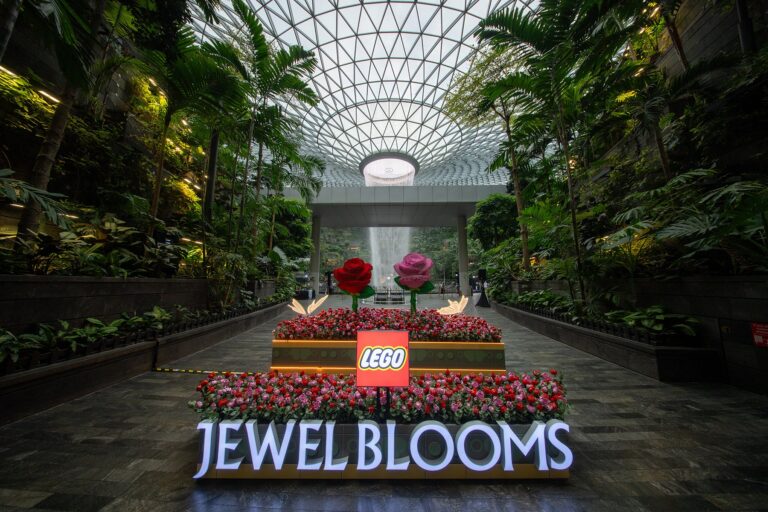
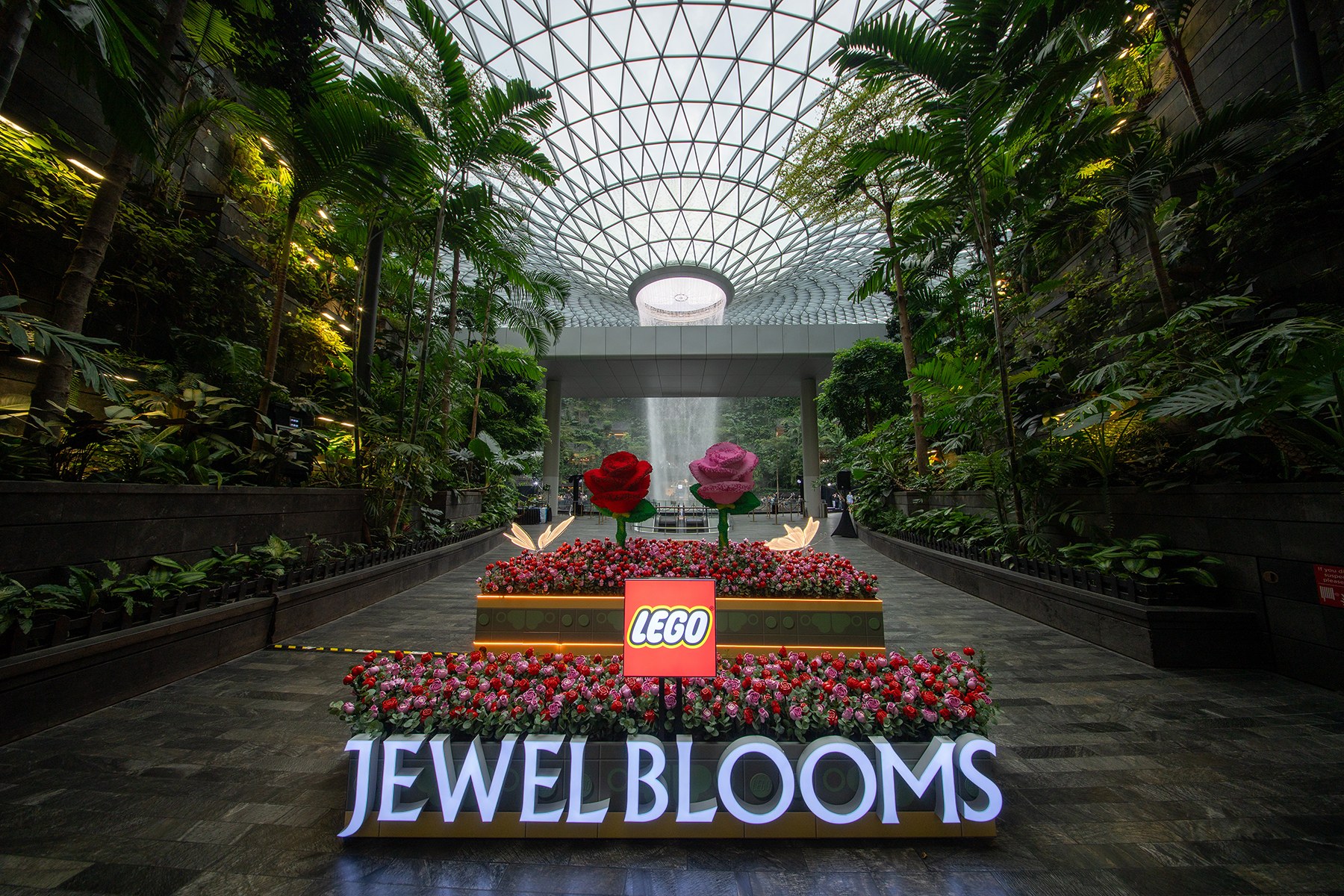
Two two-metre LEGO roses stand against the Rain Vortex at Forest Valley. (Photograph: Jewel Changi Airport)
Two LEGO roses, each two metres tall, now stand against the towering indoor waterfall at the heart of Jewel Changi Airport. They anchor a sprawl of roughly 800,000 bricks assembled into larger-than-life flora across the Singapore landmark, which LEGO and Jewel bill as Southeast Asia’s largest LEGO Botanicals mall-wide activation. It opened on 26 May, with the Forest Valley roses running to 26 July and the wider trail to 30 August. It is, first of all, a genuinely lovely thing to walk into. But the cleverer move is the one you don’t see.
That move is the siting. Most brands build a standalone footprint and then spend hard to drag people to it. LEGO did the opposite: it placed its experience inside one of the most heavily trafficked buildings on the planet and let the venue supply the audience. This is retail theatre staged as a destination, where the reach is baked into the postcode rather than bought.
The numbers behind that bet are striking, and they belong to the airport, not the exhibit. Jewel Changi reportedly drew a record 80 million-plus visitors in 2024, around 300,000 a day, with overseas travellers making up more than a third of its footfall, on the operator’s own figures. No brand could manufacture that kind of flow from a cold start. LEGO simply borrowed it, parking its garden directly in the path of a captive global crowd already moving through the space.
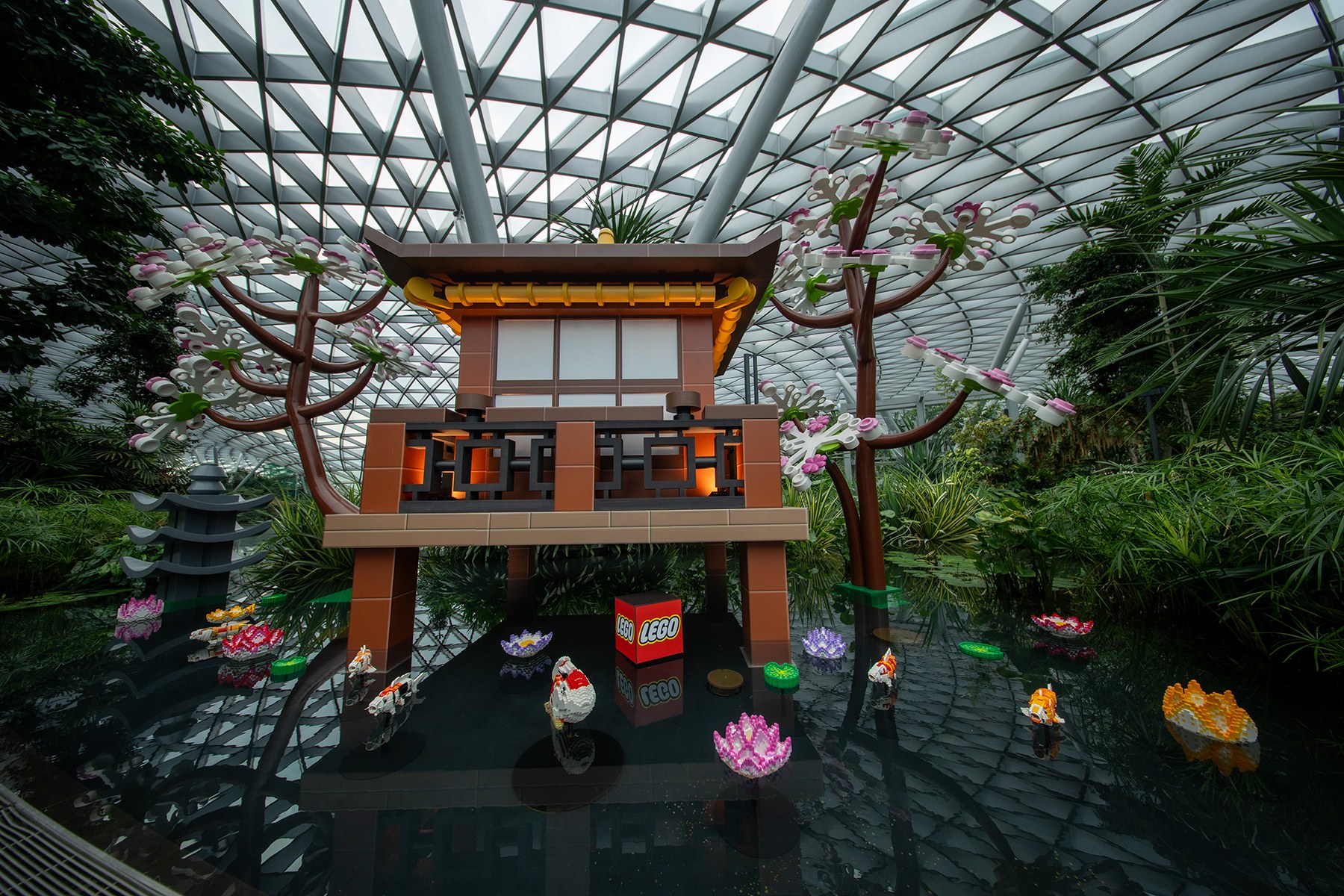
The build earns its setting. At Forest Valley, the roses play off the Rain Vortex; up at Canopy Park, a “Gardens of the World” trail runs through global horticultural vignettes rendered in brick; and at the Source Pool, a Japanese-inspired garden of LEGO koi and water lilies, modelled on LEGO’s Tranquil Garden set, gives the whole thing a quieter centre. It is florally themed for a reason that goes beyond prettiness.
That reason is Botanicals itself. LEGO’s flower-building range sits under its “Adults Welcome” banner, an 18-plus line pitched as buildable decor and a mindful, unwind-after-work hobby, blooms that never wilt. It is the vehicle for a deliberate repositioning: a brand long filed under “children’s toys” staking a claim to grown-up lifestyle relevance. Worth noting the nuance, the 18-plus framing belongs to the product line; the Jewel event itself plays all-ages, with a stamp rally and family programming on site.
And the programming is the tell that this is more than a backdrop. There is a stamp rally across seven Jewel locations, a fashion showcase staged with the Singapore Fashion Council featuring named local designers, and a dedicated pop-up store in Basement 1 with spend-tied premiums. A three-month, multi-zone run with its own shop and a fashion collaboration reads as a serious commercial commitment, not a pop-and-photo stunt.
Still, a clear eye is in order. There are no exhibit-specific footfall, dwell or sales figures, so the 80 million is Jewel’s audience, not LEGO’s result, and it shouldn’t be allowed to masquerade as one. The honest question is whether brick flowers in an airport build the brand or simply make a beautiful photo. Spectacle and dwell are not conversion, and a traveller pausing on the way to a gate is not, by that act, a customer. Proximity is not engagement.
For brand and retail teams, the borrowable lesson is about where an experience should live. Siting inside an existing destination, a transit hub, a landmark, a flagship, can out-reach anything you build from scratch, and layering real programming gives passers-through a reason to stop, play and maybe buy. The limit is just as plain: that crowd is there for the airport, not for you, and very few brands can get their hands on a venue with traffic like Jewel’s. The insight travels; the postcode mostly doesn’t.