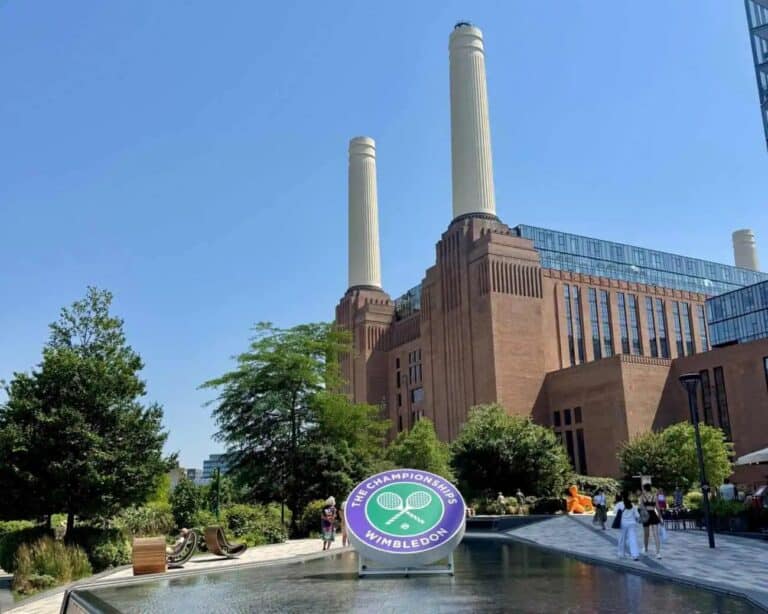
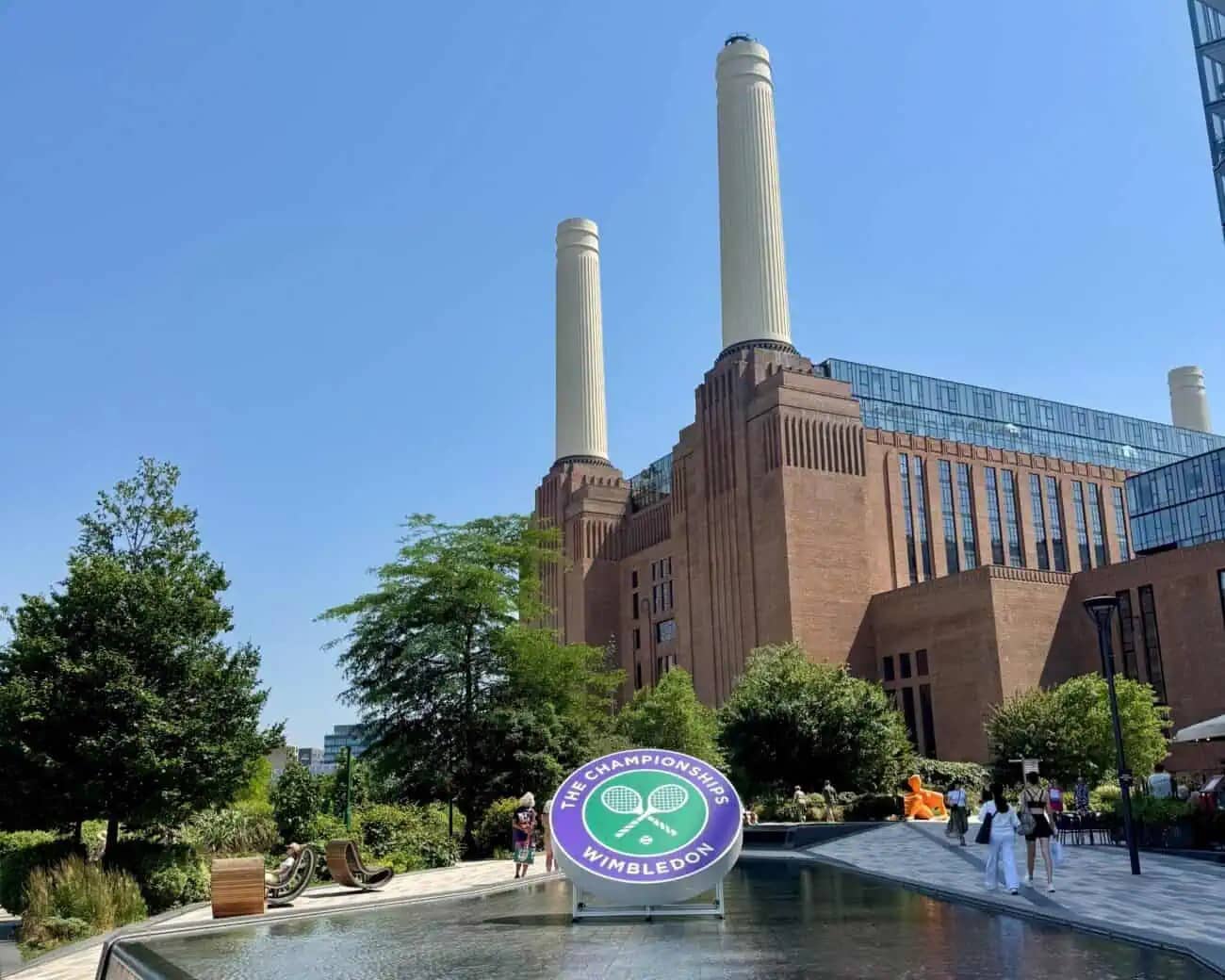
The Wimbledon Experience returns to Power Station Park at Battersea Power Station, 2026. Courtesy of Battersea Power Station
For a fortnight this summer, a slice of SW19 has been transplanted to the banks of the Thames. In Power Station Park, beside the Grade II*-listed Battersea Power Station, the official Wimbledon Experience returns with floral displays, live scoreboards, strawberries and cream, merchandise and a 15-square-metre screen carrying the BBC’s coverage. It runs from 29 June to 12 July, free and open daily, and for 2026 it has grown from what was a viewing zone into a full-blown fan village. This is what a heritage tournament extending its franchise off-site looks like when it’s done with taste rather than volume.
The story here is the scaling-up. This is the third consecutive year the Championships have set up at Battersea, and by the organisers’ account the most built-out version yet, produced by the media owner Ocean Outdoor and its production arm Ocean Labs. “We mark our ninth year working with The All England Club and the third year bringing The Wimbledon Experience to Battersea Power Station,” said Ocean Outdoor’s Rachel Sutton, a line worth quoting precisely because that ninth year belongs to Ocean’s relationship with the club, not to any single sponsor.
Underneath the pageantry sits a genuine strategic idea: reach the fans who will never get a ticket. The All England Club has always had a scarcity problem, more demand than SW19 could ever seat, and a free, public, daily village in central London quietly answers it. As the AELTC’s Brendan Dinen put it, the aim is to “bring the magic of Wimbledon to thousands of fans” beyond the grounds. It is franchise extension, not just a big screen in a park.
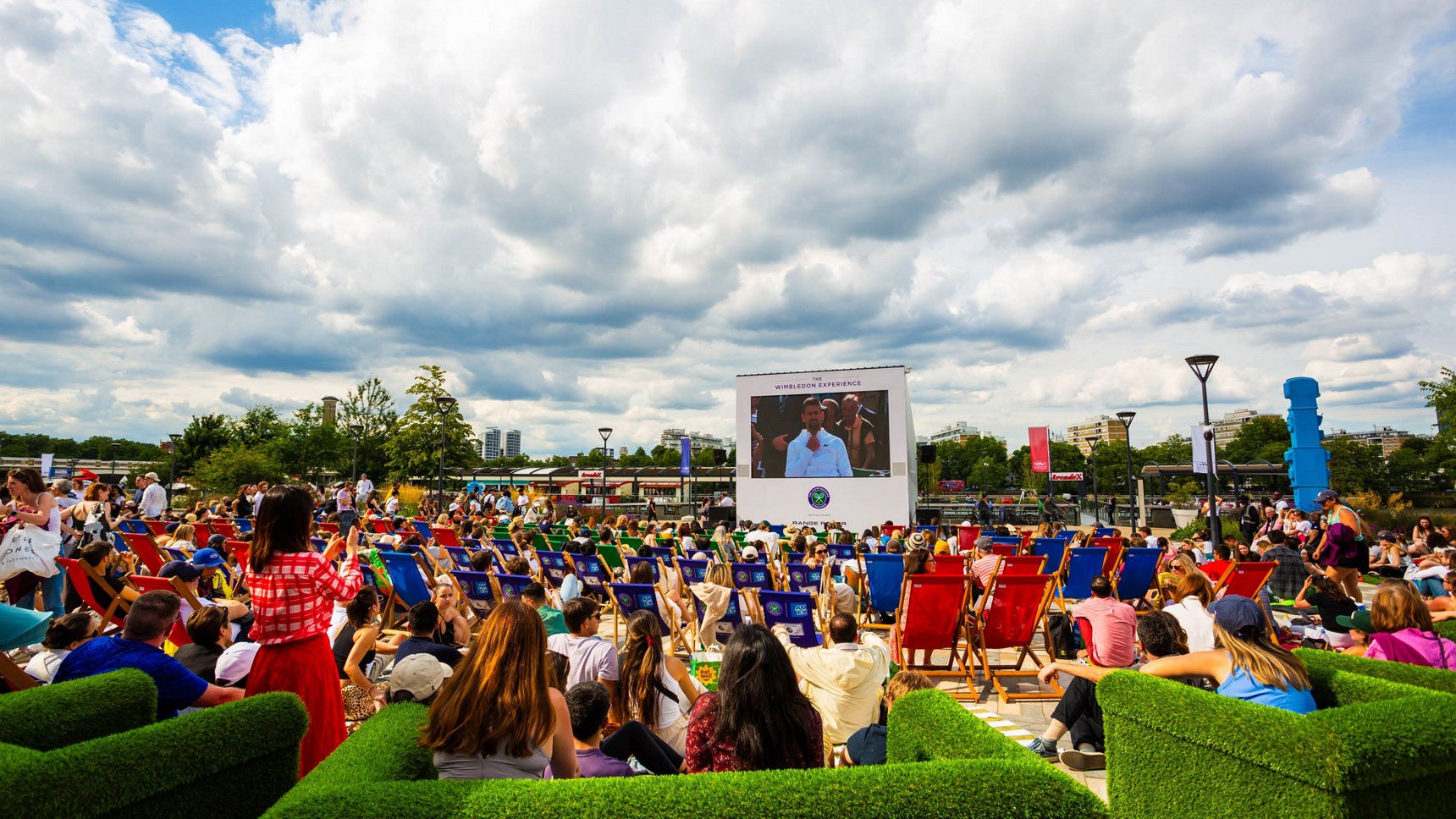
What makes it instructive is how lightly the commercial partners are worn. American Express, the Official Partner of the Championships, is present with limited-edition charms and a competition to win finals-weekend tickets; Pimm’s turns up with a branded bus. Neither shouts. Both are folded into the Wimbledon aesthetic rather than bolted on top of it, and the ticket competition does real work, offering the one thing money famously struggles to buy.
That restraint is the whole lesson, and it is harder than it looks. When a brand’s equity is its aesthetic, the greens, the whites, the strawberries, overt sponsor branding would simply clash with it. So understatement becomes the brief, and the discipline is in what you leave out. Plenty of activations could learn from a fan village confident enough not to plaster itself in logos.
It would be overselling this to call it a daring creative swing. It is a competent, on-code extension of a beloved tentpole, not a breakthrough stunt; its virtue is tasteful scale, not audacity. It sits in the same broad territory as the branded fan zones and civic viewing squares springing up around every major tournament, but where those lean on spectacle, Wimbledon leans on its own good manners.
There is also no scoreboard for it yet, in the marketing sense. No footfall, attendance or sales figures have been published, so it should be judged for what it plainly is, a live, expanded, free experience, rather than for results nobody can yet measure.
For brand and retail teams, the takeaway is twofold and honest. The official fan experience is a real brand-extension lever, a way for a tentpole to reach beyond its own gates, and on-code restraint is a genuine craft. But the whole thing rides on borrowed heritage most brands simply don’t have. You cannot recreate 150 years of strawberries and cream, or a colour palette the world reads on sight. The principle travels, extend the tentpole off-site, keep it restrained, keep it on-code. The equity that makes it sing does not.