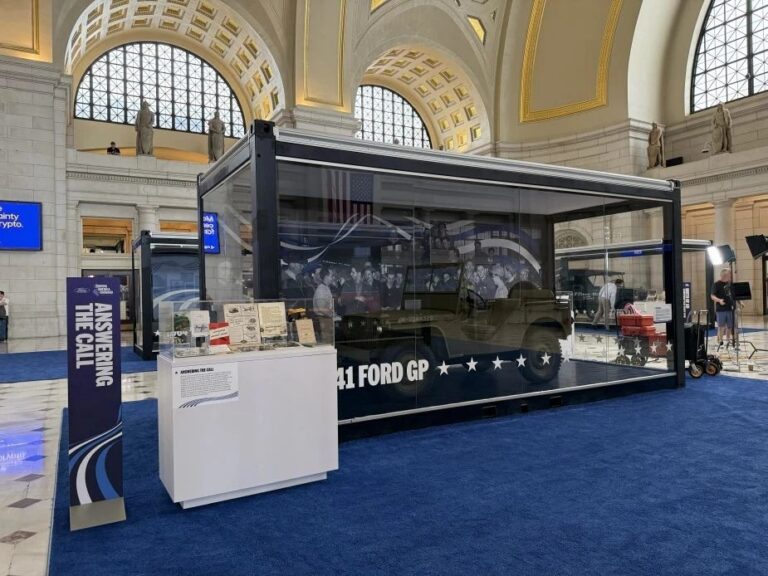
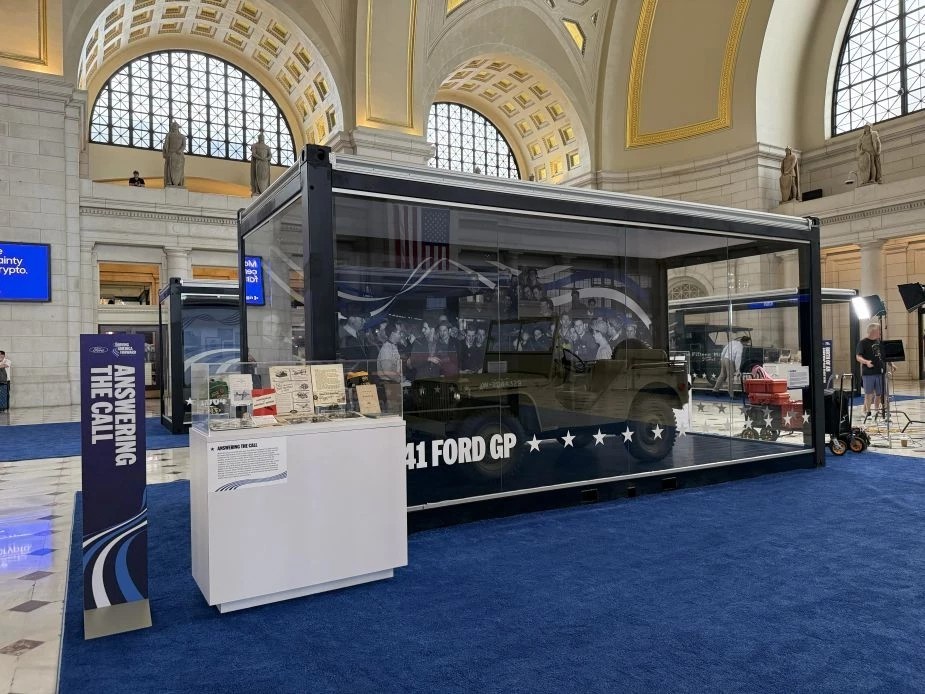
The 1941 Ford GP behind glass in the Main Hall of Union Station, part of Ford’s “Driving America Forward” exhibit. Photograph: Ford / courtesy Ford
Under the vaulted Beaux-Arts ceiling of Washington’s Union Station, in the grand Main Hall, around ten vintage Fords now sit behind museum-quality glass. The exhibit is called “Driving America Forward,” it is free, it runs from 1 to 14 July, and it marks the nation’s 250th anniversary. What it isn’t is a loud stunt. It is, in effect, a museum a 123-year-old car company built out of its own past, and that quiet confidence is the entire point.
The span does the talking. The line-up reaches from the last Model T ever built, a car that at its peak reportedly made up over half the world’s cars, to a 2026 Oracle Red Bull Formula 1 machine, confirmed on display by the exhibit’s reporting. A century and more of one company, bookended in a single room. Few brands could fill that arc; Ford barely has to reach for it.
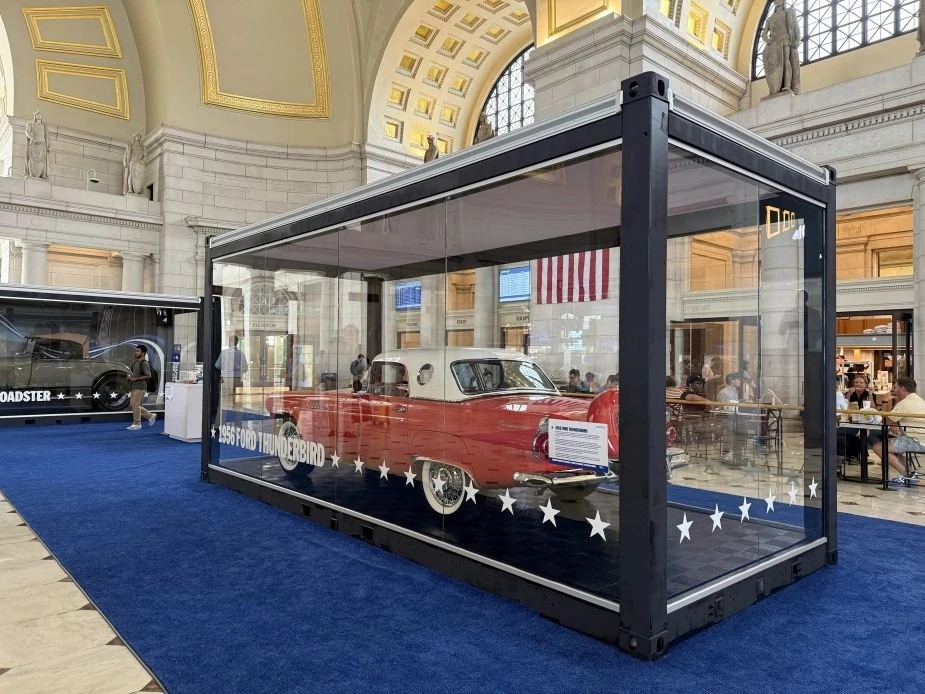
In between sits a genuinely charming spread. There’s a 1928 Model A Roadster, a 1934 Flatbed V8 pickup on loan from Jay Leno, the 1941 Ford GP that fathered the military Jeep, a 1951 8N tractor, a 1954 F-100, the 1956 Thunderbird, a 1964 Mustang from the New York World’s Fair, and a 1966 Stroppe Baja Bronco. The vehicles are curated into themes, among them Shaping Pop Culture, American Innovations and 125 Years of Racing, so the hall reads as a narrative rather than a car park.
The sharpest material is the stuff you’d never guess. Alongside the cars, the archival displays cover Ford’s work in mail-sorting technology, barcode and ZIP-code readers, and contributions to Apollo’s Mission Control. As Ford’s heritage manager Ted Ryan framed the intent, “what we want people to walk away saying is, ‘Oh my gosh, I didn’t know Ford did that.’” That surprise is the exhibit’s real currency.
What makes the whole thing instructive is the restraint. A brand with this much equity could have built a noisy, hands-on spectacle; instead Ford framed its history like a museum, glass cases, themes, a considered story, and let the objects carry it. Even the interactive layer is deliberately understated: a postcard-keepsake station and a full-wall LED gallery, and little else. Produced by the experience agency Imagination out of its Detroit office, and staged in a marquee civic building that does work no fabricated booth could, it treats reticence as a form of confidence.
A clear eye is still worth keeping. Museum-grade heritage is admired more than it is interacted with; glass, by design, holds you at arm’s length. So it’s fair to ask whether this builds the brand or simply gives people who already love Ford a pleasant nostalgia lap. And there are no exhibit-specific numbers to settle it. Ryan calls Union Station “so incredibly visited,” but that’s the venue’s traffic, not a measure of what the show moved.
The more generous read, voiced independently, is that anyone can cut a nostalgic advert, and choosing hardware-driven storytelling over another film is a harder, more considered move than it looks. On that reading it’s more than a lap of honour, even if the proof isn’t in yet.
For brand and retail teams, the lesson is that the archive is an experiential asset most legacy brands sit on and never open. Museum-grade curation is a credibility play, the discipline being to trust the objects and stay out of their way. The honest limit is built in, though: it only works if your history is genuinely rich and legible. A young brand has no vault to open, and you cannot curate heritage you don’t have. The principle travels. The century in the room does not.